- Published
- July 2010
- Page Count
- 412
- ISBN (Digital)
- 978-1-4533-2768-5
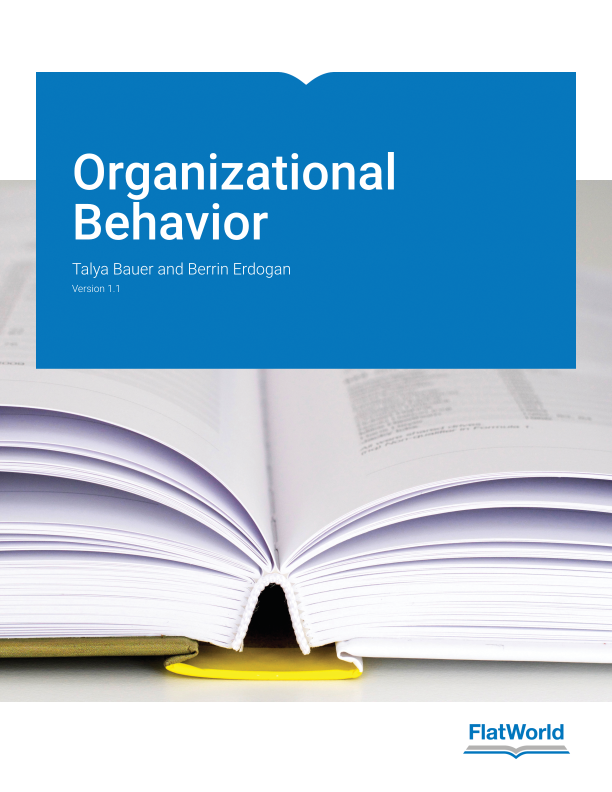
Organizational Behavior
Version 1.1
By Talya Bauer and Berrin Erdogan
Included Supplements
 Manual
 Slides
 Tests
Tests

Key Features
Teach Organizational Behavior? Adopt this college textbook as is or personalize it online at Flat World. Change chapter titles, move content with ease, and delight in how much less your students pay. We publish peer-reviewed textbooks by expert authors. You make them perfect for your course.
Organizational Behavior, v. 1.1
Talya Bauer & Berrin Erdogan
WHAT'S NEW IN 1.1:
- TOOLS FOR LIFELONG LEARNERS:
In order to succeed in a constantly changing job market, individuals need to be armed with the tools necessary for lifelong learning. To that end, this book is not about giving students answers to every situation they may encounter in their careers. Instead, the book provides the vocabulary, framework, and critical thinking skills necessary to diagnose situations, ask tough questions, evaluate answers received, and to act in an effective and ethical manner regardless of situational characteristics.
- EXPERIENTIAL APPROACH & “OB TOOLBOX”:
Often, students taking OB either do not understand how important knowledge of OB can be to their professional careers, or they DO understand and they want to put that knowledge into practice. Organizational Behavior takes a more experiential angle to the material to meet both of those needs. This approach can be incorporated in the classroom through the <aref=”http://catalog.flatworldknowledge.com/bookhub/reader/4?e=fwk-122425-ch12#fwk-122425-ch12_s04”>“OB Toolbox,” which brings life to concepts and allows students to not only see how OB theories unfold, but to practice them, as well.
In writing Organizational Behavior, v. 1.1,Talya Bauer and Berrin Erdogan, two leading researchers in management, had simple aims:
- To bridge the gap between theory and practice of management with a distinct “experiential” approach.
This textbook is suitable for these courses: Organizational Behavior, Managerial Behavior
This textbook is suitable for 2 and 4 year institutions.
PEDAGOGICAL FEATURES:
- HEADS UP:
Sometimes, students struggle to understand confusing concepts or ideas. Each concept is covered with a ”Heads Up“ to ward off confusion from the very beginning.
- YOU TRY IT:
Hands-on learning is highly effective. A ”You Try It“ section gives students the reins to walk through economic scenarios themselves, ensuring they also stay on top of important concepts
- CUSTOMIZABILITY:
The Flat World Knowledge publishing model allows instructors to adapt the textbook to the exact needs of their specific class and student body.
See how easy it is to customize a textbook in this 4 minute demo: Flat World Editing Platform Video Demo
- About the Authors
- Acknowledgments
- Dedications
- Preface
-
Chapter 1: Organizational Behavior
-
Chapter 2: Managing Demographic and Cultural Diversity
-
Chapter 3: Understanding People at Work: Individual Differences and Perception
-
Chapter 4: Individual Attitudes and Behaviors
-
Chapter 5: Theories of Motivation
-
Chapter 6: Designing a Motivating Work Environment
-
Chapter 7: Managing Stress and Emotions
-
Chapter 8: Communication
-
Chapter 9: Managing Groups and Teams
-
Chapter 10: Conflict and Negotiations
-
Chapter 11: Making Decisions
-
Chapter 12: Leading People Within Organizations
-
Chapter 13: Power and Politics
-
Chapter 14: Organizational Structure and Change
-
Chapter 15: Organizational Culture

Instructor’s Manual
The Instructor’s Manual guides you through the main concepts of each chapter and important elements such as learning objectives, key terms, and key takeaways. Can include answers to chapter exercises, group activity suggestions, and discussion questions.

PowerPoint Lecture Notes
A PowerPoint presentation highlighting key learning objectives and the main concepts for each chapter are available for you to use in your classroom. You can either cut and paste sections or use the presentation as a whole.

Test Generator
Prefer printable tests? Download our test generator and start creating printable tests today! We offer a test generator for both PC and Mac users.

Test Bank Files for Import to Learning Management Systems
For your convenience, we've packaged our test items for easy import into Learning Management Systems like Blackboard, Brightspace/D2L, Canvas, Moodle, or Respondus.

Test Item File
Need assistance in supplementing your quizzes and tests? Our test-item files (in Word format) contain many multiple-choice, fill-in-the-blank, and short-answer questions.

Other Supplements
Solutions manuals, sample exams, video learning segments, workbooks, cases and lab manuals are just some of the extras our books will offer depending on the needs of the course. Click here to see what this textbook offers.
At FlatWorld, we take pride in providing a range of high-quality supplements alongside our titles, to help instructors teach effectively. Supplements are available for instructors who have registered their adoption with us. If you need to review or preview something specific, please contact us.
Already registered? Sign in here.