- Published
- June 2014
- Page Count
- 500
- ISBN (Digital)
- 978-1-4533-6510-6
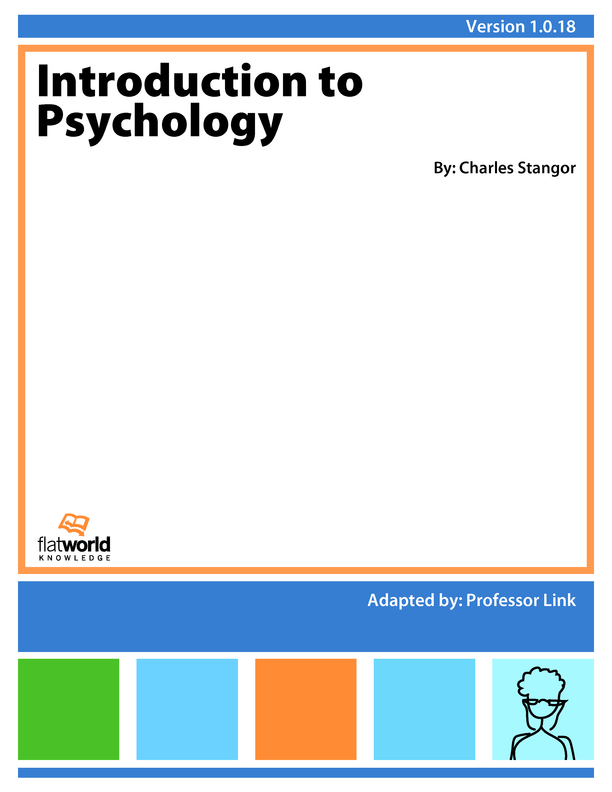
Introduction to Psychology
Custom Version 1.0.18
By Charles Stangor
Tom Link
Included Supplements
 Manual
 Slides
 Tests
Tests
Key Features
Teaching Introduction to Psychology? Adopt this college textbook as is or personalize it online at Flat World. Change chapter titles, move content with ease, and delight in how much less your students pay. We publish peer-reviewed textbooks by expert authors. You make them perfect for your course.
Students
- About the Author
- Acknowledgments
- Dedication
- Preface
-
Chapter 1: Asking Good Psychological Questions
-
Chapter 2: Learning Styles
-
Chapter 3: Social Psychology: Helping, Influence, and Obedience
-
Chapter 4: Stress, Anxiety Disorders and Classical Conditioning
-
Chapter 5: Treating Psychological Disorders with emphasis on Cognitive Therapy
-
Chapter 6: Psychological Science
-
Chapter 7: Social Psychology: Stereotypes
-
Chapter 8: Brains, Bodies, and Behavior
-
Chapter 9: Emotions, an Introduction to Psychological Disorders, and Depression
-
Chapter 10: Schemas: Piaget's Cognitive Development
-
Chapter 11: Schemas: Memory
-
Chapter 12: Personality
-
Chapter 13: Visual Perception, Schizophrenia, Medications, Sleeping
-
Chapter 14: Psychology Advising

Instructor’s Manual
The Instructor’s Manual guides you through the main concepts of each chapter and important elements such as learning objectives, key terms, and key takeaways. Can include answers to chapter exercises, group activity suggestions, and discussion questions.
PowerPoint Lecture Notes
A PowerPoint presentation highlighting key learning objectives and the main concepts for each chapter are available for you to use in your classroom. You can either cut and paste sections or use the presentation as a whole.
Test Generator
Prefer printable tests? Download our test generator and start creating printable tests today! We offer a test generator for both PC and Mac users.
Test Bank Files for Import to Learning Management Systems
For your convenience, we've packaged our test items for easy import into Learning Management Systems like Blackboard, Brightspace/D2L, Canvas, Moodle, or Respondus.
Test Item File
Need assistance in supplementing your quizzes and tests? Our test-item files (in Word format) contain many multiple-choice, fill-in-the-blank, and short-answer questions.
At FlatWorld, we take pride in providing a range of high-quality supplements alongside our titles, to help instructors teach effectively. Supplements are available for instructors who have registered their adoption with us. If you need to review or preview something specific, please contact us.
Already registered? Sign in here.