- Published
- March 2012
- Page Count
- 320
- ISBN (Digital)
- 978-1-4533-4379-1
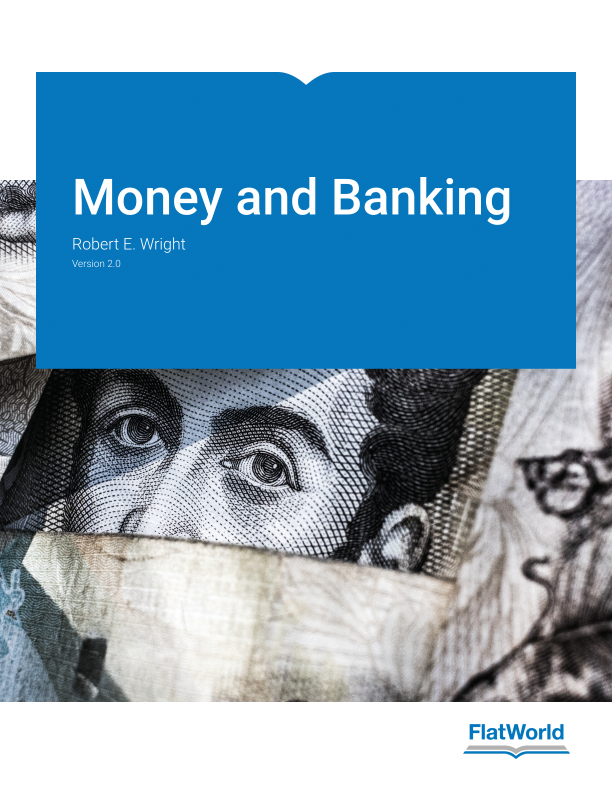
Money and Banking
Version 2.0
By Robert E. Wright
Key Features
Teach Money & Banking? Adopt this college textbook as is or personalize it online at Flat World. Change chapter titles, move content with ease, and delight in how much less your students pay. We publish peer-reviewed textbooks by expert authors. You make them perfect for your course.
Listen to a podcast here of Robert discussing his textbook and gain perspective on why he wrote a Money and Banking text.
The financial crisis of 2007-8 has already revolutionized institutions, markets, and regulation. Wright's Money and Banking V 2.0 captures those revolutionary changes and packages them in a way that engages undergraduates enrolled in Money and Banking and Financial Institutions and Markets courses.
Minimal mathematics, accessible language, and a student-oriented tone ease readers into complex subjects like money, interest rates, banking, asymmetric information, financial crises and regulation, monetary policy, monetary theory, and other standard topics. Numerous short cases, called "Stop and Think" boxes, promote internalization over memorization. Exercise drills ensure basic skills competency where appropriate. Short, snappy sections that begin with a framing question enhance readability and encourage assignment completion.
The 2.0 version of this text boasts substantive revisions (additions, deletions, rearrangements) of almost every chapter based on the suggestions of many Money and Banking instructors.
Some specific highlights are: Chapter 11 now contains enhanced descriptions of recent regulatory changes, including Dodd-Frank, Chapter 12 is an entirely new chapter on derivatives covering forwards, futures, options, and swaps that also including comprehensive treatment of the causes and consequences of financial crises, and Chapter 14 has updated discussions of the Federal Reserve’s monetary policy tools, including paying interest on reserves, and the structure and leadership of the European Central Bank.
Recent financial turmoil has increased student interest in the financial system but simultaneously threatens to create false impressions and negative attitudes. This up-to-date text by a dynamic, young author encourages students to critique the financial system without rejecting its many positive attributes. Peruse the book online now to see for yourself if this book fits the needs of your course and students.
- About the Author
- Acknowledgments
- Preface
-
Chapter 1: Money, Banking, and Your World
-
Chapter 2: The Financial System
-
Chapter 3: Money
-
Chapter 4: Interest Rates
-
Chapter 5: The Economics of Interest-Rate Fluctuations
-
Chapter 6: The Economics of Interest-Rate Spreads and Yield Curves
-
Chapter 7: Rational Expectations, Efficient Markets, and the Valuation of Corporate Equities
-
Chapter 8: Financial Structure, Transaction Costs, and Asymmetric Information
-
Chapter 9: Bank Management
-
Chapter 10: Innovation and Structure in Banking and Finance
-
Chapter 11: The Economics of Financial Regulation
-
Chapter 12: Financial Derivatives
-
Chapter 13: Financial Crises: Causes and Consequences
-
Chapter 14: Central Bank Form and Function
-
Chapter 15: The Money Supply Process and the Money Multipliers
-
Chapter 16: Monetary Policy Tools
-
Chapter 17: Monetary Policy Targets and Goals
-
Chapter 18: Foreign Exchange
-
Chapter 19: International Monetary Regimes
-
Chapter 20: Money Demand
-
Chapter 21: IS-LM
-
Chapter 22: IS-LM in Action
-
Chapter 23: Aggregate Supply and Demand and the Growth Diamond
-
Chapter 24: Monetary Policy Transmission Mechanisms
-
Chapter 25: Inflation and Money
-
Chapter 26: Rational Expectations Redux: Monetary Policy Implications