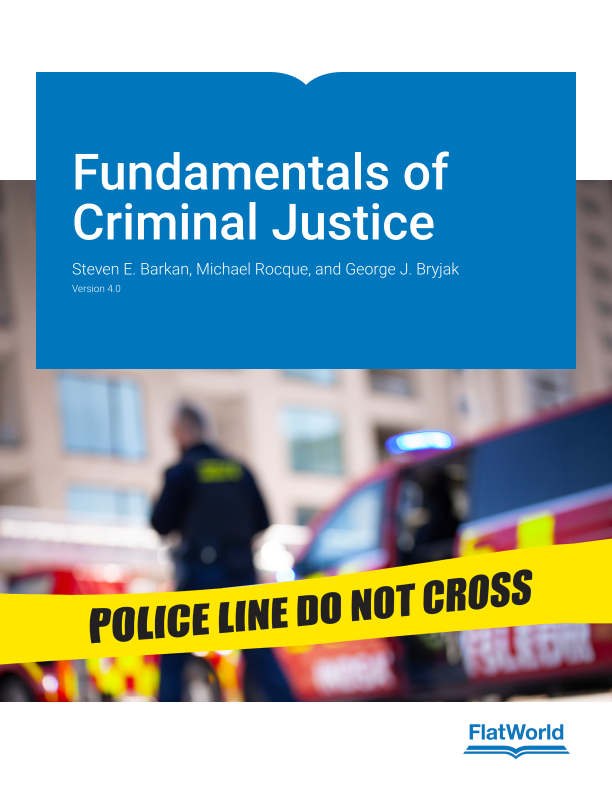
Fundamentals of Criminal Justice



Version 4.0
By Steven E. Barkan, Michael Rocque, and George J. Bryjak
Included Supplements
 Homework
 Manual
 Slides
 Tests

Key Features
- This textbook provides students with a timely and comprehensive view of the police, the criminal courts, and corrections in the United States, demystifying much of what students learn from media and other sources
- Each chapter features "It's Your Call" vignettes that provide students a chance to use critical thinking in relation to reality-based scenarios
- More than 70 all-new embedded hyperlinks to streaming videos enrich learning, engage students, and reinforce or augment many of the presented topics
- Supportive learning structure:
- “Learning Objectives” at the beginning of each main section outline key concepts covered in that section
- “Key Takeaways” at the end of main head sections are aligned with that section’s Learning Objectives to reinforce retention
- Marginal Glossary of Key Terms allows students to easily review key term definitions by skimming through the text
- Thought-provoking “Questions for Exploration” are found at the end of every chapter
- The “Summary” at the end of each chapter recapitulates key points and stimulates retention
- Customizable
Students
- Online Access Price
- $34.95
- Color Printed Textbook with Online Access Price
- $61.95
Fundamentals of Criminal Justice delivers a sharp, realistic introduction to the American criminal justice system. Moving beyond popular conceptions, Barkan, Rocque, and Bryjak encourage students to evaluate how the police, courts, and corrections actually function in the real world and how these elements can be improved.
The text streamlines the complex justice landscape into three critical pillars:
- Structural Reality: How the system operates in practice versus its theoretical design
- Systemic Inequality: The defining impact of race and ethnicity on justice outcomes
- Capacity for Change: The system’s actual ability to control crime through current methods versus future reforms
By blending a thorough examination with a concise narrative, this book equips students with the tools to understand current controversies in the criminal justice system and to assess its potential to keep Americans safe from crime.
New in This Version
- Increased attention to the role played by race and ethnicity in the operation of the criminal justice system
- New material on commercial bail companies, bail reform, and the monetary and criminal justice consequences of wrongful convictions
- Expanded discussions of criticism of cash bail and parole effectiveness
- New data on juvenile arrests for homicide since 1990
- Updated data on Americans’ concerns about crime; home security; criminal justice expenditures; incarceration; violence against women; crime and crime trends; clearance rates; gender arrests for homicide; hate crimes; sexual assault victimization; police suicide, stress, and burnout; race and drug arrests; correctional population data; sociodemographic data of people on probation; parole effectiveness; parole violation; school victimizations; and race and juvenile court processing
In Progress
- All instructor supplements will be available by November 30, 2026.
- Homework system for this title will be live by November 30, 2026.
- About the Authors
- Acknowledgments
- Preface
-
Chapter 1: Crime and Justice in American Society
-
Chapter 2: Understanding and Measuring Crime
-
Chapter 3: Victims, Victimization, and Criminal Justice
-
Chapter 4: Criminal Law
-
Chapter 5: History and Organization of Police
-
Chapter 6: Understanding Police Work
-
Chapter 7: Issues in Policing
-
Chapter 8: Criminal Courts: History, Organization, and Principal Players
-
Chapter 9: Criminal Proceedings: From Arrest to Trial
-
Chapter 10: Sentencing
-
Chapter 11: Prisons and Punishment: Yesterday and Today
-
Chapter 12: Life Behind Bars
-
Chapter 13: Community Corrections
-
Chapter 14: Juvenile Justice
-
Chapter 15: Epilogue: The Future of Criminal Justice

FlatWorld Homework
FlatWorld Homework includes multi-format questions written specifically for your FlatWorld book, which you can access through our stand-alone interface or integrate with your learning management system.

Instructor’s Manual
The Instructor’s Manual guides you through the main concepts of each chapter and important elements such as learning objectives, key terms, and key takeaways. Can include answers to chapter exercises, group activity suggestions, and discussion questions.

PowerPoint Lecture Notes
A PowerPoint presentation highlighting key learning objectives and the main concepts for each chapter are available for you to use in your classroom. You can either cut and paste sections or use the presentation as a whole.

Test Generator - powered by Cognero
FlatWorld has partnered with Cognero, a leading online assessment system, that allows you to create printable tests from FlatWorld provided content.

Test Bank Files for Import to Learning Management Systems
For your convenience, we've packaged our test items for easy import into Learning Management Systems like Blackboard, Brightspace/D2L, Canvas, Moodle, or Respondus.

Test Item File
Need assistance in supplementing your quizzes and tests? Our test-item files (in Word format) contain many multiple-choice, fill-in-the-blank, and short-answer questions.
Sample Syllabi
Sample syllabi provide useful templates to help new faculty adopters revise their teaching plans to match their assigned FlatWorld textbook or lend insights to existing adopters on how to organize their classes.
DownloadAt FlatWorld, we take pride in providing a range of high-quality supplements alongside our titles, to help instructors teach effectively. Supplements are available for instructors who have registered their adoption with us. If you need to review or preview something specific, please contact us.
Already registered? Sign in here.