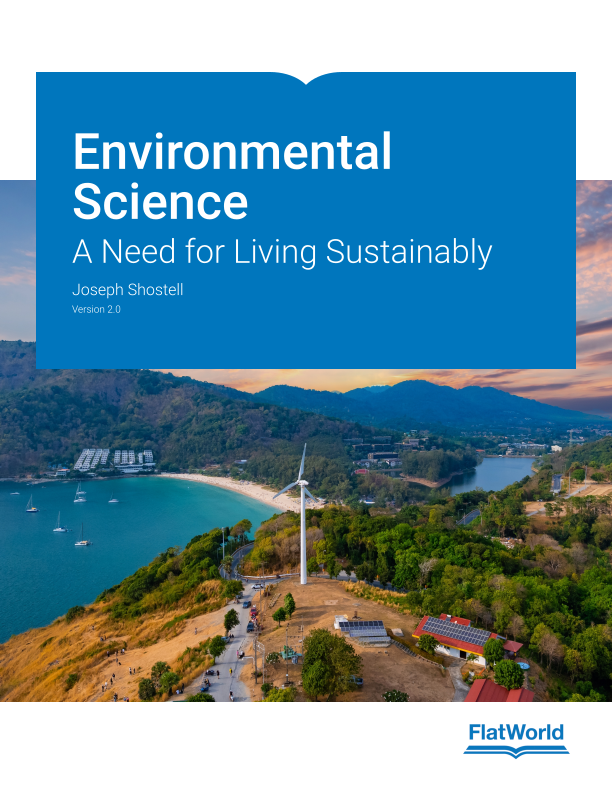
Environmental Science: A Need for Living Sustainably



Version 2.0
By Joseph Shostell
Included Supplements
 Manual
 Slides
 Tests

Key Features
- Presents a positive, "can-do" attitude by offering solutions and productive steps that can be taken to tackle environmental challenges
- Structured around seven interconnected themes described in Section 1.3:
- Life and society need a healthy environment to thrive
- Science informs us about the environment
- Societal, corporate, and consumer decisions impact the environment
- Environmental issues have a social and cultural context
- A global perspective is needed to deal with many environmental issues
- Society relies on many disciplines to solve environmental problems
- Sustainability allows future generations to enjoy a healthy environment
- Early coverage of ethics (Chapter 2)
- Introduces matter and energy as foundational topics (Chapter 3)
- Critical Thinking Activities in each chapter prompt students to analyze key topics in depth, such as genetically modified organisms (Section 2.3) or solid waste disposal (Section 16.2)
- Bringing It Closer to Home activities in each chapter invite students to investigate their personal environment outside the classroom to explore topics such as product designs (Section 2.3), estimating habitat loss (Section 7.3), and identifying their own risk of exposure to ozone (Section 11.4)
- Over 90 embedded video links throughout bring topics to life and encourage student engagement
- Fully customizable
Students
- Online Access Price
- $37.95
- Color Printed Textbook with Online Access Price
- $64.95
Environmental Science: A Need for Living Sustainably is appropriate for courses called Introduction to Environmental Science, Environmental Science, Environmental Studies, or similar titles taught at the undergraduate level in two- and four-year colleges and universities.
Environmental Science: A Need for Living Sustainably delivers a modern, fast-paced approach to the field. By merging captivating global narratives with hands-on experiential activities, this text reinforces foundational concepts through real-world application. Its streamlined structure tackles complex topics more efficiently than traditional competitors—allowing faculty to cover more ground without sacrificing student retention.
New in This Version
- Updated carbon footprint data (Section 1.1)
- Enhanced discussion of an individual's power to effect positive change in society, referencing Wangari Maathai and the reforestation project (Section 2.5)
- Added discussion of recent inclement weather events such as Hurricanes Helene and Milton in 2024 (Section 5.4)
- Updated population growth data and total fertility rate data (Sections 6.1 and 6.2)
- Updated atmospheric carbon dioxide data (Section 7.3)
- Added discussion of the effects of war (including the ongoing war in Ukraine) on agriculture and food security (Section 8.1)
- Updated global food losses and livestock data (Section 8.2)
- Added information about the EPA's decision to prohibit the use of the pesticide chlorpyrifos (Section 8.5)
- New coverage of threats to the Amazon, such as the weakening of the Soy moratorium (Section 9.5)
- Updated bottled water consumption data (Section 10.2)
- Coverage added on the water demands of Las Vegas and the status of Lake Mead (Section 10.3)
- Added new image of Antarctic's ozone hole and new discussion on Earth's protective ozone (Figure 11.4)
- Updated energy use data (Section 13.1)
- Discussion of new breakthroughs in the nuclear energy industry (Section 13.5)
- Added discussion of the U.S. Department of Energy's support of algal based biofuels (Section 14.2)
- Updated information on the efficiency of solar panels and the number of solar panels, and associated costs, needed for an average-sized house (Section 14.3)
- New information on the leading human mortality factors, including COVID-19, in the United States and in the world (Section 15.1)
- New graph and discussion on antimicrobial resistance (Section 15.4)
- Updated society waste data (Chapter 16 Case Study and Section 16.1)
- Update on the transformation of Puente Hills Landfill into a community park (Section 16.2)
- Updated plastic bag ban information (Section 16.2)
- Updated information on the home activity titled "Exploring the Degree of Surface Impervious to Water in Your Community" (Section 17.1)
- Updated transportation network data (Section 17.3)
- Updated economic policies affecting environmental protection, such as congestion pricing in New York City (Chapter 18 Case Study)
In Progress
- All instructor supplements will be available by December 31, 2026.
- Homework system for this title will be live by December 31, 2026.
- About the Author
- Acknowledgments
- Preface
-
Chapter 1: Introduction to Environmental Science: Sustainability
-
Chapter 2: Environmental Ethics, Law, and Policy
-
Chapter 3: Matter, Energy, and the Environment
-
Chapter 4: Evolution, Populations, and Communities
-
Chapter 5: Ecosystems and Biomes
-
Chapter 6: Human Populations
-
Chapter 7: Preserving Biodiversity
-
Chapter 8: Agriculture, Food, and the Environment
-
Chapter 9: Sustainable Management of Forests, Grasslands, and Protected Areas
-
Chapter 10: Water Resources
-
Chapter 11: Air Quality, Climate Change, and Air Pollution
-
Chapter 12: Geology and Mineral Resources
-
Chapter 13: Nonrenewable Energy Sources
-
Chapter 14: Renewable Energy Sources
-
Chapter 15: Environmental Health and Toxicology
-
Chapter 16: Solid and Hazardous Waste
-
Chapter 17: Sustainable Community Development and Urbanization
-
Chapter 18: Sustainable Economics

Instructor’s Manual

PowerPoint Lecture Notes
A PowerPoint presentation highlighting key learning objectives and the main concepts for each chapter are available for you to use in your classroom. You can either cut and paste sections or use the presentation as a whole.
Test Generator - powered by Cognero
FlatWorld has partnered with Cognero, a leading online assessment system, that allows you to create printable tests from FlatWorld provided content.

Test Bank Files for Import to Learning Management Systems
For your convenience, we've packaged our test items for easy import into Learning Management Systems like Blackboard, Brightspace/D2L, Canvas, Moodle, or Respondus.

Test Item File
Need assistance in supplementing your quizzes and tests? Our test-item files (in Word format) contain many multiple-choice, fill-in-the-blank, and short-answer questions.
Sample Syllabi
Sample syllabi provide useful templates to help new faculty adopters revise their teaching plans to match their assigned FlatWorld textbook or lend insights to existing adopters on how to organize their classes.
DownloadAt FlatWorld, we take pride in providing a range of high-quality supplements alongside our titles, to help instructors teach effectively. Supplements are available for instructors who have registered their adoption with us. If you need to review or preview something specific, please contact us.
Already registered? Sign in here.