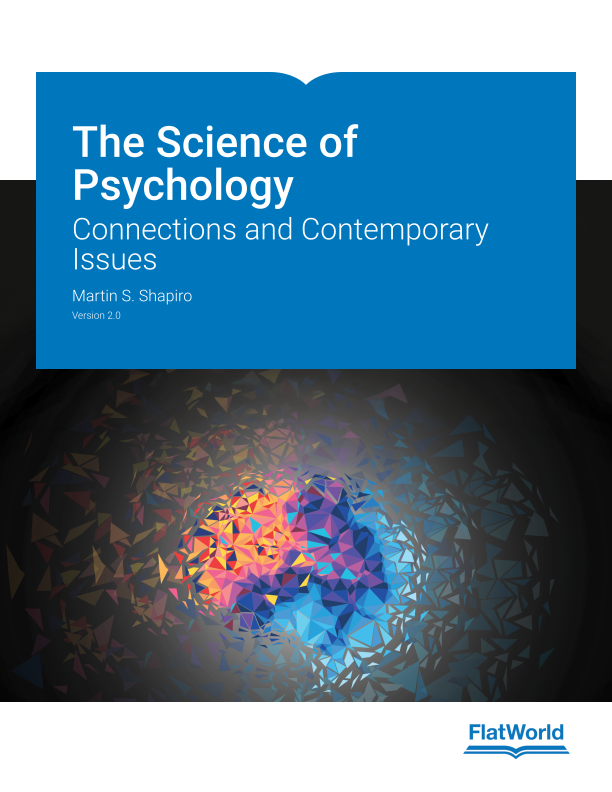
The Science of Psychology: Connections and Contemporary Issues


Version 2.0
By Martin S. Shapiro
Included Supplements
 Homework
 Manual
 Slides
 Tests
Tests

Key Features
- The Science of Psychology: Connections and Contemporary Issues delivers the most complete and compelling view of the field with a robust 16 total chapters, including a separate chapter on behavioral genetics and evolutionary psychology (Chapter 3) and a separate chapter on sex, gender, and love (Chapter 11)
- A unique, full section on social media and mental health (Section 12.4)
- Addresses and dispels common myths, misconceptions, and scams about psychology
- Winner of the 2024 TAA Most Promising New Textbook Award
- Giving students what they want: over 290 embedded links to curated videos and webpages (many new to this version), engage students, stimulate curiosity, and enrich all learning experiences
- Supportive learning elements in each chapter:
- "Myths, Lies, and Scams" feature occurs 27 times throughout the book to examine popular beliefs about different fields of psychology; expose partial truths, complete misunderstandings, and outright falsehoods; and encourage students to develop a critical approach to consuming information. Examples of such myths include MSG in Chinese food causes neurological problems (Section 2.2); brain supplements improve cognitive ability (Section 8.4), or that there are five distinct stages of grief (Section 10.4)
- "Connections" at the end of every main section explore the many ways different subfields of psychology are intertwined with one another. Examples include pain perception and the opioid crisis (Section 5.4), the role of sense and perception in attraction (Section 11.3), and adverse childhood experiences and risk factors for disorders (Section 14.2)
- "Contemporary Issues" sections at the end of every chapter show how the chapter relates to a key, modern-day topic such as artificial intelligence and consciousness (Section 4.5), artificial intimacy (Section 11.5), and political partisanship (Section 12.5)
- "Key Takeaways" at the end of each main section reflect the corresponding Learning Objectives and summarize key ideas in bullet-point fashion. Key Takeaways enable the learner to pause and consolidate the information just read or experienced into a "chunk." This process enables the reader to better understand and retain the section’s content and its key concepts
- "End-of-Chapter Content" can be used to create excellent homework assignments and facilitate class discussions. They also encourage further exploration, develop information literacy, and demonstrate the relevance of psychology
- "Best Online Content" provides links to rich, online resources for learning more about psychology. Selected for the sense of wonder and engagement they foster, these resources consist of short talks, videos, podcasts, articles, and documentaries from world-renowned experts. Examples include selections from Ted Talks, Radiolab, Hidden Brain, Crash Course, and SciShow
- "Suggested Popular Science Books" provides references to popular books about neuroscience and behavior written by experts in the field for a general audience. Each carefully researched suggestion provides students with another high-interest way to connect with the field. Examples include works by Robert Sapolsky, Malcolm Gladwell, Helen Fisher, Oliver Sacks, and David Eagleman
- "Short Answer Questions" and "Discussion Questions" for assignment or independent student study highlight key concepts and content in the preceding chapter. These questions stimulate analysis and deeper understanding
- Multiple choice questions for "Best Online Content" and class discussion guidelines with suggested answer rubrics for "Short Answer" and "Discussion Questions" are provided in the instructor’s manual
- All supplements are written by the textbook’s author
- Fully Customizable
Students
- Online Access Price
- $37.95
- Color Printed Textbook with Online Access Price
- $64.95
This textbook is suitable for courses called Psychology, Introduction to Psychology, Principles of Psychology, or for any basic psychology course that provides an overview of the discipline. The course is generally taught at the undergraduate level and at most two-and four-year colleges and universities.
The Science of Psychology: Connections and Contemporary Issues helps students explore the science of the mind interwoven with the topics of psychology that matter today. Shapiro delivers a thorough and accurate picture of the expansive field of psychology while maintaining student engagement and readability and giving full attention to topics that matter to today’s students. Many faculty members doubt that an introductory psychology textbook, explicitly grounded in the scientific method, can connect and resonate with their students, yet this textbook proves that it can.
Highly praised by peer reviewers, the conversational writing style weaves together psychology’s scientific foundations with creative and effective learning features. The result: a compellingly written introductory textbook that appeals to learners with a broad range of preparation, demystifies psychology throughout, explicitly unifies connections between psychology’s subfields, and explores today’s high-interest topics and issues.
New in This Version
New topics praised by peer reviewers include:
- Chapter 13 "Personality"—a new contemporary issues section was added called "Our Virtual Self," discussing how our personalities may be presented differently on social media and online gaming
- Chapter 14 "Psychological Disorders"—a new section was added about social media, mental health, and self-diagnosis
- More coverage of diverse voices throughout, including added sections about Kenneth and Mamie Clark’s famous "doll study" in both Chapters 1 and 12, and an added section on the groundbreaking historical contribution made by Black and Hispanic researchers such as Horace Mann Bond, George Sanchez, Mamie Phipps Clark, Kenneth Clark, and Robert Lee Williams
- Other updated information included such topics as psychedelics and therapy, SNPs and behavioral genetics, theories of dreaming, opioid addiction and treatment, technology and perception, cyberpsychology, the negative influence of social media, and artificial intelligence and ChatGPT
- More than 100 new references have been added to Version 2.0
- About the Author
- Dedication
- Acknowledgments
- Preface
-
Chapter 1: The Science of Psychology
-
Chapter 2: Neuroscience
-
Chapter 3: Behavioral Genetics and Evolutionary Psychology
-
Chapter 4: Consciousness
-
Chapter 5: Senses and Perception
-
Chapter 6: Learning
-
Chapter 7: Motivation and Emotions
-
Chapter 8: Cognitive Psychology and Memory
-
Chapter 9: Intelligence, Language, and Decision Making
-
Chapter 10: Development and Lifespan
-
Chapter 11: Sex, Gender, and Love
-
Chapter 12: Social Psychology
-
Chapter 13: Personality
-
Chapter 14: Psychological Disorders
-
Chapter 15: Treatments for Psychological Disorders
-
Chapter 16: Stress and Health Psychology

FlatWorld Homework
FlatWorld Homework includes multi-format questions written specifically for your FlatWorld book, which you can access through our stand-alone interface or integrate with your learning management system.

AI Activities
AI activities guide students through using AI effectively on real assignments, with grading rubrics built in so instructors can assess the process, not just the output.

Instructor’s Manual
The Instructor’s Manual guides you through the main concepts of each chapter and important elements such as learning objectives, key terms, and key takeaways. Can include answers to chapter exercises, group activity suggestions, and discussion questions.

PowerPoint Lecture Notes
A PowerPoint presentation highlighting key learning objectives and the main concepts for each chapter are available for you to use in your classroom. You can either cut and paste sections or use the presentation as a whole.
Test Generator - powered by Cognero
FlatWorld has partnered with Cognero, a leading online assessment system, that allows you to create printable tests from FlatWorld provided content.

Test Bank Files for Import to Learning Management Systems
For your convenience, we've packaged our test items for easy import into Learning Management Systems like Blackboard, Brightspace/D2L, Canvas, Moodle, or Respondus.
Test Item File
Need assistance in supplementing your quizzes and tests? Our test-item files (in Word format) contain many multiple-choice, fill-in-the-blank, and short-answer questions.
At FlatWorld, we take pride in providing a range of high-quality supplements alongside our titles, to help instructors teach effectively. Supplements are available for instructors who have registered their adoption with us. If you need to review or preview something specific, please contact us.
Already registered? Sign in here.
Additions & Errata
10/23/26:
Section 6.2: Broken link for the video titled, "Puzzle Box Thorndike" updated.