- Published
- September 2025
- Page Count
- 848
- ISBN (Digital)
- 979-8-88794-509-5
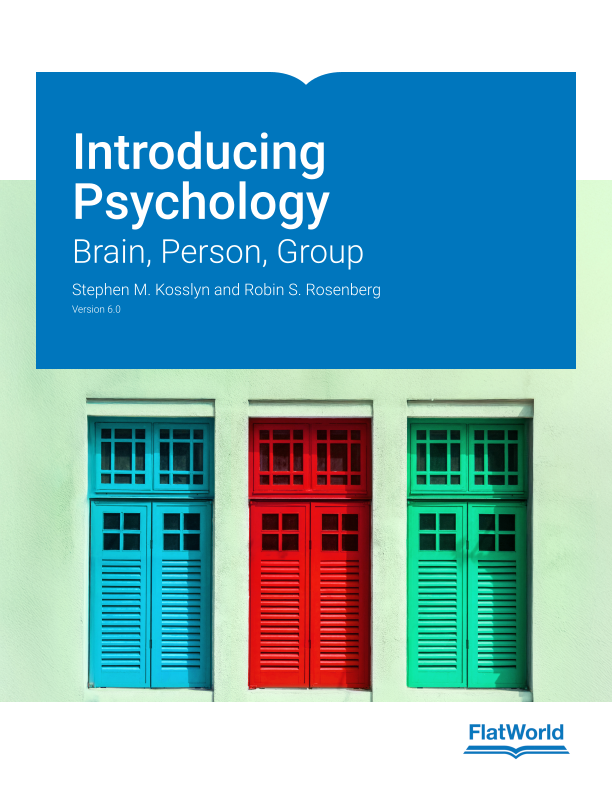
Introducing Psychology: Brain, Person, Group

Version 6.0
By Stephen M. Kosslyn and Robin S. Rosenberg
Included Supplements
 Homework
 Manual
 Slides
 Tests
Tests

Key Features
- Mainstream approach built around three levels of analysis (brain, person, group) helps students understand psychology in a more holistic and memorable way
- Engages students by demonstrating how psychological principles are relevant to everyday life using provocative chapter-opening stories and features such as Think Like a Psychologist
- Over 65 embedded hyperlinks to streaming videos enrich hybrid and online courses, engage students, and reinforce or augment many of the presented topics
- Balances theory and application through its unique partnership of key researcher and clinical psychologist
- Evaluated by an eminent panel of psychology scholars and teaching faculty who provided a broad survey of pertinent, replicated scholarship, and specific suggestions for incorporating such research
- Supportive learning structure
- Chapter Story introduces the chapter by conveying a story about a person or group that is woven throughout the subsequent narrative. These stories engage the reader, integrate topics into a coherent framework, and make the information more relatable and memorable
- Looking Ahead: Learning Objectives at the beginning of each main section preview the material to come and prepare students to learn
- Looking at Levels focuses on a key chapter topic, either a theory or a psychological phenomenon, and considers it in detail from all three levels of analysis (brain, person, group). The reader explores how the levels interact to create a richer understanding of the topic
- Think Like a Psychologist are brief exercises that apply psychological principles in a concrete context to help learners better understand how psychology affects how we think, feel, and behave
- Looking Back: Key Takeaways at the end of each main section reflect the corresponding Looking Ahead: Learning Objectives and summarize key ideas in bullet-point fashion. These Key Takeaways enable the learner to pause and consolidate the information just read or experienced into a "chunk." This process enables the reader to better understand and retain the section’s content and its key concepts
- End-of-Chapter
- Chapter Review provides a section-by-section outline of the chapter’s material. These outlines highlight key points that students should know after a thorough reading of the material. They help consolidate into memory the core material even further
- Key Terms list aids students in mastering key psychological vocabulary. Key terms are highlighted in context within the text, and their definitions are provided in a marginal glossary that runs throughout each chapter, while the terms are also listed in an alphabetized end-of-book index
- Practice Test consisting of 15 multiple-choice questions with answers provided in Appendix B. Includes both factual and conceptual questions to assess knowledge, identify areas for additional study, and further consolidate memories of learned material
- Try It! application activities allow learners to experience how psychology affects them personally
- Customizable
Students
- Online Access Price
- $37.95
- Color Printed Textbook with Online Access Price
- $64.95
Introducing Psychology: Brain, Person, Group is suitable for courses called Introduction to Psychology, Principles of Psychology, Survey of Psychology, or for any basic psychology course that provides an overview of the discipline. The course is generally taught at the undergraduate level at most two- and four-year colleges and universities.
Introducing Psychology: Brain, Person, Group presents psychology using levels of the brain, person, and social world to help students actively apply psychology to their lives. Examining psychological concepts from the levels of the brain (biological factors), the person (beliefs, desires, and feelings), and the world (social, cultural, and environmental factors) helps students organize and integrate topics within and across chapters—and readily see the relevance of psychology to their own lives. This comprehensive introduction to psychology both engages students and provides them with an integrated introduction to the field.
New in This Version
Overall: With over 600 new citations, and nearly 300 of those from research publishing post-2020, this new version introduces substantive new research into every chapter
Chapter 1—Introduction to the Science of Psychology: History and Research Methods
- Updated chapter story, reflecting on the reasons for Tiger Woods’s dramatic downfall and subsequent activities
- Updated discussion features women and people of color who were early pioneers in psychology, as well as modern-day researchers and their contributions
Chapter 2—The Biology of Mind and Behavior: The Brain in Action
- Revised definition of key term mental contents
- Revised Figures 2.1, 2.2, 2.4, and 2.5 to better explain the role neurotransmitters play in our brains
- How deep brain stimulation (DBS) is being used to treat neurological disorders
Chapter 3—Sensation and Perception: How the World Enters the Mind
- Repetition blindness and why it occurs
- The impact of attentional blink on working memory
Chapter 4—Learning: How Experience Changes Us
- Over 20 new citations, with 15 post-2020
- Additional context for Jackie Chan, the subject of the chapter story
- Revised Figure 4.2 to further explain how conditioning occurs
- Virtual reality (VR) as an exposure treatment technique for phobias
Chapter 5—Memory: Living With Yesterday
- Over 35 new citations
- Revised definition of key term memory store
- Why working memory is important and how it degrades as we age
- Revised definition of key term recognition
Chapter 6—Language, Thinking, and Intelligence: What Humans Do Best
- Over 25 new research citations
- New key term phonemic restoration effect
- New discussion of aphantasia in which the brain does not form or use mental images
- Revised definition of key term problem
- Updated criteria for the diagnosis of an intellectual disability
Chapter 7—Emotion and Motivation: Feeling and Striving
- Over 20 new research citations
- Expanded detail on the set of seven “emotional operating systems”
- Revised distinction between fear and happiness
- How “emodiversity” can be more beneficial than just positive emotions
- The costs of living in an individualistic society
- Overcoming a natural tendency to be passive
- Revised discussion of obesity and body mass index (BMI)
- Expanded coverage of transgender and intersex individuals, sex hormones, and hormone supplements
- Heavily revised section on sexual orientation describing the wide range of variations and how biological factors can influence sexual orientation
Chapter 8—Personality: Vive La Difference!
- Over 65 new research citations, with over 25 post-2020
- How defense mechanisms can impact adult behavior, even leading to persistent psychological issues
- How neuroscientists evaluate brain functioning for evidence of Freudian defense mechanisms
- How narrowed characteristics for personality assessment can improve accuracy of life domain predictions
- Condensed coverage of projective tests and their limitations
- Individual’s ability to adjust to social isolation during the pandemic
- Adaptive coping mechanisms during the pandemic
- Brain structure and neuroscience research applied to the brain-based foundations of the Big Five traits
- Revised research on genetic influences on personality
- How the relationship between socioeconomic development and individualism can change over time
Chapter 9—Psychology Over the Life Span: Growing Up, Growing Older, Growing Wiser
- Over 130 new research citations, with 40 from post-2020 with updated statistics throughout the chapter
- Negative impacts of maternal stressors on language, cognition, temperament, social behavior, and motor development
Chapter 10—Stress, Health, and Coping: Dealing with Life
- Over 95 new research citations, with over 50 post-2020
- Revised definition of key term stress
- Responses to physical stressors by the brain and body compared to psychological or social stressors
- Negative emotions in response to stress can predict more negative health outcomes
- Impacts of stress and sleep on academic performance
- Updated statistics related to drug and alcohol usage
Chapter 11—Psychological Disorders: More than Everyday Problems
- Over 45 new research citations and revised statistics throughout the chapter
- Psychological disorder symptoms expressed differently across cultures
- Revised Table 11.1 to feature disorders covered by the chapter informed by DSM-5-TR
- DSM-5-TR definitions
- The three groups that schizophrenia symptom groupings: positive, negative, and disorganized
Chapter 12—Treatment: Healing Actions, Healing Words
- Nearly 40 new research citations post-2020
- Integrative therapists
Chapter 13—Social Psychology: Meeting of the Minds
- Nearly 80 new research citations
- Revised explanation of explicit and implicit attitudes
- New section on stereotype threat
- New section on snap judgments
- New section on digital matchmaking
- About the Authors
- Acknowledgments
- Dedication
- Preface
-
Chapter 1: Introduction to the Science of Psychology: History and Research Methods
-
Chapter 2: The Biology of Mind and Behavior: The Brain in Action
-
Chapter 3: Sensation and Perception: How the World Enters the Mind
-
Chapter 4: Learning: How Experience Changes Us
-
Chapter 5: Memory: Living With Yesterday
-
Chapter 6: Language, Thinking, and Intelligence: What Humans Do Best
-
Chapter 7: Emotion and Motivation: Feeling and Striving
-
Chapter 8: Personality: Vive La Difference!
-
Chapter 9: Psychology Over the Life Span: Growing Up, Growing Older, Growing Wiser
-
Chapter 10: Stress, Health, and Coping: Dealing With Life
-
Chapter 11: Psychological Disorders: More Than Everyday Problems
-
Chapter 12: Treatment: Healing Actions, Healing Words
-
Chapter 13: Social Psychology: Meeting of the Minds
-
Appendix A: Statistics and How to Think About Research Studies
-
Appendix B: Answers to Practice Tests
-
Appendix C: References
FlatWorld Homework
FlatWorld Homework includes multi-format questions written specifically for your FlatWorld book, which you can access through our stand-alone interface or integrate with your learning management system.

AI Activities
AI activities guide students through using AI effectively on real assignments, with grading rubrics built in so instructors can assess the process, not just the output.
Instructor’s Manual
The Instructor’s Manual guides you through the main concepts of each chapter and important elements such as learning objectives, key terms, and key takeaways. Can include answers to chapter exercises, group activity suggestions, and discussion questions.
PowerPoint Lecture Notes
A PowerPoint presentation highlighting key learning objectives and the main concepts for each chapter are available for you to use in your classroom. You can either cut and paste sections or use the presentation as a whole.
Test Generator - powered by Cognero
FlatWorld has partnered with Cognero, a leading online assessment system, that allows you to create printable tests from FlatWorld provided content.
Test Bank Files for Import to Learning Management Systems
For your convenience, we've packaged our test items for easy import into Learning Management Systems like Blackboard, Brightspace/D2L, Canvas, Moodle, or Respondus.
Test Item File
Need assistance in supplementing your quizzes and tests? Our test-item files (in Word format) contain many multiple-choice, fill-in-the-blank, and short-answer questions.
Sample Syllabi
Sample syllabi provide useful templates to help new faculty adopters revise their teaching plans to match their assigned FlatWorld textbook or lend insights to existing adopters on how to organize their classes.
DownloadAt FlatWorld, we take pride in providing a range of high-quality supplements alongside our titles, to help instructors teach effectively. Supplements are available for instructors who have registered their adoption with us. If you need to review or preview something specific, please contact us.
Already registered? Sign in here.
Additions & Errata
5/23/26:
Section 13.2: Broken "The Milgram Experiment" video link was replaced.